Lateral Ulnar Collateral Ligament (LUCL) Reconstruction Protocol
Phase-by-phase post-operative rehabilitation protocol for Lateral Ulnar Collateral Ligament (LUCL) reconstruction to guide recovery and physical therapy.
A reconstruction of the Lateral Ulnar Collateral Ligament (LUCL) is performed to treat posterolateral rotatory instability (PLRI) of the elbow. The goal of this rehabilitation protocol is to protect the healing tendon graft, gradually restore pain-free range of motion, and rebuild elbow, forearm, and shoulder strength. Progression is criterion-based and guided by soft-tissue healing and surgeon-specific precautions. Forearm position and restriction of varus forces are vital to protect the reconstructed ligament during the early recovery phases.
Phase I: Protection & Early Motion (Weeks 0–6)
Goals:
- Protect the healing LUCL graft and surgical incision
- Manage post-operative pain, swelling, and inflammation
- Maintain active range of motion (AROM) of the fingers, wrist, and shoulder
- Begin gentle elbow motion within safe limits, avoiding varus stress
Precautions & Restrictions:
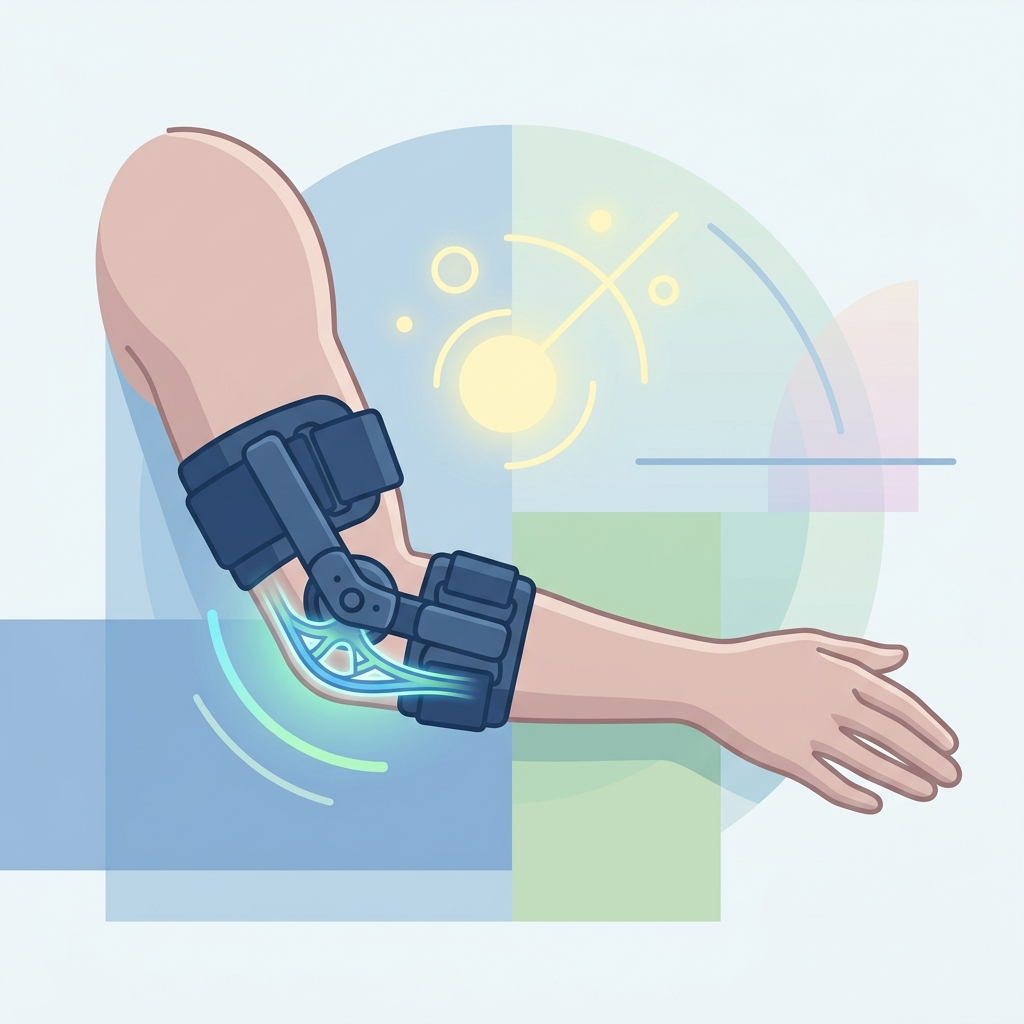
- Splint/Brace: Hinged elbow brace worn at all times (including sleep). Weeks 0-2: Locked at 90° flexion. Weeks 2-6: Brace unlocked for controlled motion. Set extension limit at 30° flexion (to prevent stress on the healing graft) and flex to 100° (or as tolerated).
- No Varus Stress: Avoid all activities that push the forearm away from the body. Keep the shoulder in neutral rotation/adduction (do not abduct the arm or reach behind your back).
- Forearm Rotation Limit: Forearm rotation (pronation and supination) must only be performed at 90° of elbow flexion. Strictly avoid forearm supination when the elbow is extended. Keep the forearm pronated (palm down) during elbow extension to protect the lateral structures.
- Lifting: Non-weight-bearing (restricted to light items no heavier than a coffee cup, e.g., <1 lb).
Suggested Exercises:
- Grip strengthening (e.g., putty, soft ball squeeze)
- Active range of motion (AROM) for fingers, wrist, and hand
- Active-assisted elbow flexion and extension within brace limits (flexion to 100°, extension blocked at 30°) performed with forearm in pronation
- Forearm pronation and supination exercises performed strictly at 90° of elbow flexion (avoiding end-range supination)
- Shoulder shrugs, scapular retraction, and shoulder isometrics (avoiding external rotation and abduction)
Criteria to Progress:
- Healing of surgical incision and well-controlled pain/swelling
- Elbow flexion to 100° and extension to 30°
- Safe compliance with brace guidelines and activity restrictions
Phase II: Intermediate Range of Motion & Strength (Weeks 6–12)
Goals:
- Gradually wean from the hinged elbow brace
- Restore full, pain-free elbow and forearm range of motion (ROM)
- Initiate light strengthening of the elbow, forearm, wrist, and shoulder
- Maintain scapular and rotator cuff strength, preventing compensation patterns
Precautions & Restrictions:
- Brace Weaning: Wean from the hinged brace between weeks 6 and 8 as directed by your surgeon.
- Varus Loading: Continue to avoid varus stress on the elbow (avoid shoulder abduction/internal rotation during lifting).
- Lifting: Slowly progress lifting from 1 lb to a maximum of 5 lbs by week 12. No sudden jerking or heavy carrying.
Suggested Exercises:
- Active and passive elbow extension and flexion to achieve full, symmetric ROM (perform extension stretch with forearm pronated or neutral)
- Active and passive forearm pronation and supination at various angles of elbow flexion
- Submaximal isometric strengthening for elbow flexion, extension, pronation, and supination
- Progressive resistance exercises (PREs) with light bands or 1-2 lb weights for wrist flexion/extension, forearm pronation/supination, and elbow flexion/extension
- Scapular stabilization (rows, Y/T/W exercises) and light rotator cuff strengthening (shoulder external/internal rotation with bands)
Criteria to Progress:
- Full, pain-free elbow and forearm range of motion
- Normal, non-painful daily activities (ADLs) without a brace
- Minimum of 10-12 weeks post-surgery for starting advanced resistance training
Phase III: Advanced Strengthening & Conditioning (Weeks 12–18+)
Goals:
- Restore full muscular strength and endurance of the upper extremity
- Re-establish normal neuromuscular control and stability of the elbow joint
- Prepare for return to recreational activities, work, and sports
Precautions & Restrictions:
- Avoid sudden loading or high-impact varus forces (e.g., heavy overhead lifting or falling on an outstretched arm)
- All strengthening must be progressive and pain-free
Suggested Exercises:
- Progressive resistance strengthening using dumbbells, cables, or bands (biceps curls, triceps press-downs, forearm strengthening)
- Scapular and rotator cuff strengthening to achieve >80% strength compared to the unaffected side
- Elbow neuromuscular stability exercises (e.g., throwing/catching a medicine ball against a rebounder, weight-bearing stabilization on unstable surfaces)
- Light plyometrics (starting at weeks 12-14, ensuring good control and no pain)
- Sport-specific or work-specific drill progressions (e.g., light shadow-swinging, batting drills, or simulated tool use)
Criteria to Progress:
- Full, pain-free elbow range of motion in all planes
- Elbow and shoulder strength at least 80-85% of the contralateral side
- Pain-free completion of all intermediate-level strengthening and light plyometrics
Phase IV: Return to Sport & Activity (Weeks 18–26+)
Goals:
- Gradual return to full, unrestricted athletic or work activities
- Match or exceed pre-injury strength and conditioning levels
- Prevent re-injury through proper biomechanics and ongoing maintenance work
Precautions & Restrictions:
- Return to sports or heavy manual labor must be cleared by your surgeon
- Avoid overloading the joint if pain or swelling recurs
Suggested Exercises:
- Continuation of upper extremity strengthening, focusing on power and endurance
- Structured interval program for throwing athletes (e.g., baseball, softball) or racket/golf athletes
- Full-intensity plyometrics and sport-specific training drills
Criteria for Return to Play:
- Surgeon clearance
- Pain-free performance of all sports-related movements
- Elbow and forearm strength >90% compared to the unaffected side
- Normal scapular and rotator cuff control during dynamic movement
These guidelines represent a standard rehabilitation protocol. Individual recovery rates vary significantly depending on the size of the repair, bone/tissue quality, and general patient health. Your surgeon may modify this protocol specifically for you.
Disclaimer: This protocol is for educational purposes and is not a substitute for professional medical advice. Always consult your surgeon or physical therapist before performing any exercises or modifying activity restrictions.

Related articles
Browse all articlesTrusted External Resources
Curated educational materials to help you make informed decisions about your orthopaedic bone & joint conditions.

Orthopaedia
Orthogate Patient Education