
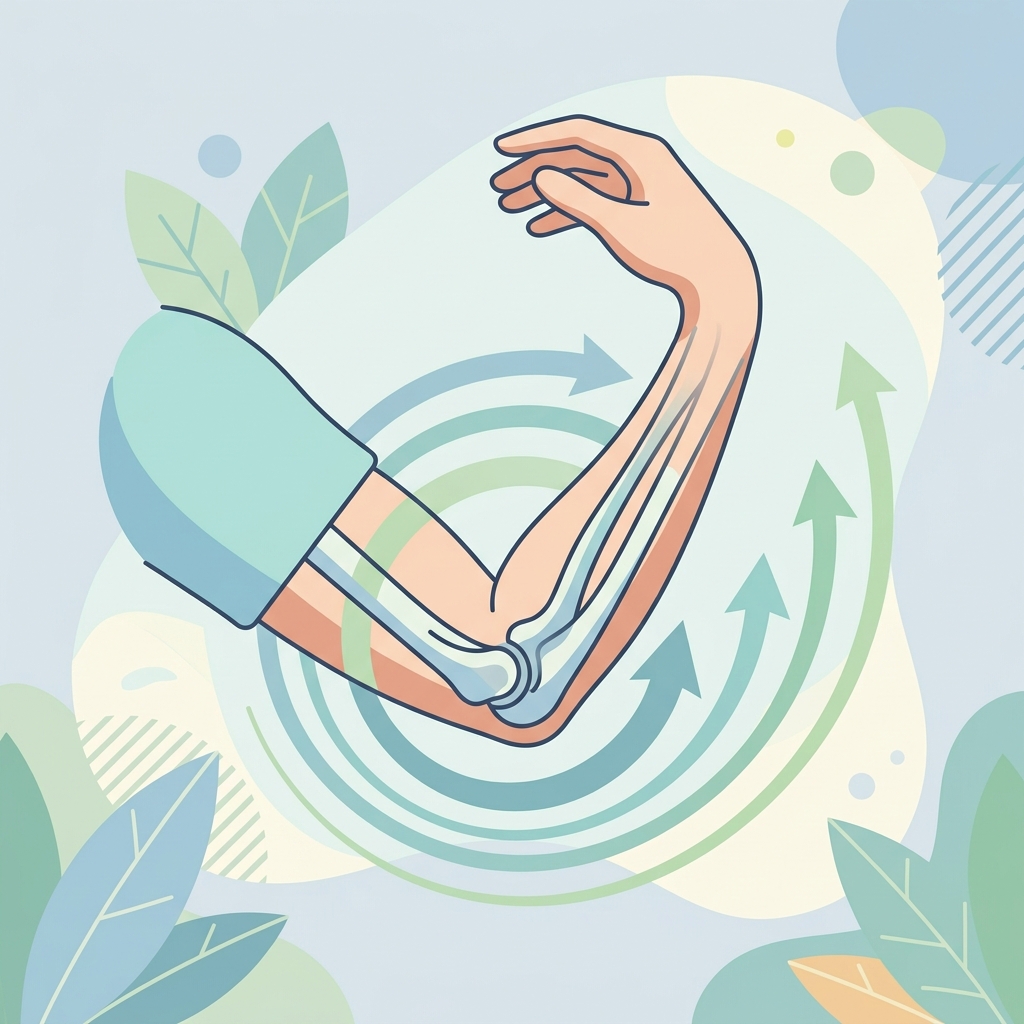
Elbow Arthroscopy and Debridement Protocol
Phase-by-phase post-operative rehabilitation protocol for Elbow Arthroscopy and Debridement to guide recovery and physical therapy.
Elbow arthroscopy and debridement is a minimally invasive surgical procedure used to remove loose bodies, shave bone spurs (osteophytes), release capsular contractures, or debride inflamed tissue (synovium) within the elbow joint. Because the procedure preserves surrounding muscle and tendon attachments, rehabilitation is focused on early range of motion (ROM) to prevent joint stiffness while allowing portal incisions to heal. A structured, progressive therapy program helps patients restore full elbow function, strength, and mobility.
Phase 1: Protection and Early Range of Motion (Weeks 0-2)
Goals:
- Control pain, swelling, and inflammation.
- Protect healing arthroscopic portal incisions.
- Initiate early, gentle range of motion within comfortable limits.
- Maintain wrist, hand, and shoulder mobility.
Precautions and Restrictions:
- Avoid aggressive passive stretching or forcing range of motion past tolerance.
- No lifting, pulling, or pushing heavy objects (limit to less than 1-2 lbs).
- Keep portal incisions clean and dry; keep dressing intact until advised by your surgical team.
- Do not immobilize the elbow in a sling for prolonged periods; use only for comfort during travel.
Suggested Exercises:
- Active-assisted and active range of motion (ROM) for elbow flexion and extension.
- Active-assisted and active forearm rotation (pronation and supination) to comfort.
- Hand and wrist range of motion exercises (fist clenches, wrist flexion/extension).
- Grip strengthening using soft putty or a squeeze ball.
- Shoulder active range of motion (elevation, abduction) to prevent shoulder stiffness.
Criteria to Progress:
- Well-controlled pain and minimal joint swelling.
- Portal incisions fully healed and dry.
- Elbow range of motion demonstrating progress toward extension and flexion goals without severe pain.
Phase 2: Intermediate Range of Motion and Light Strengthening (Weeks 2-6)
Goals:
- Restore full active and active-assisted range of motion (ROM) in all planes.
- Transition to light strengthening of the elbow, forearm, and shoulder.
- Return to light, non-resistive activities of daily living (ADLs).
Precautions and Restrictions:
- Avoid sudden jerking motions or rapid loading of the elbow joint.
- No heavy lifting (limit to 5 lbs).
- Avoid painful or high-impact activities.
Suggested Exercises:
- Progressive active stretching to reach end-range elbow extension, flexion, pronation, and supination.
- Gentle joint mobilization if needed (performed by a physical therapist).
- Light isometric strengthening for elbow flexion, extension, pronation, and supination.
- Light isotonic exercises using resistance bands or very light weights (1-2 lbs), including biceps curls, triceps press-downs, and wrist curls.
- Scapular stabilization exercises (rows, Y/T/W exercises) and rotator cuff strengthening.
Criteria to Progress:
- Full or near-full active range of motion equal to the opposite side.
- No pain or swelling with light activities of daily living.
- Sufficient baseline strength to initiate progressive resistance.
Phase 3: Advanced Strengthening and Functional Return (Weeks 6-12+)
Goals:
- Normalize elbow, forearm, and upper extremity strength, power, and muscular endurance.
- Achieve and maintain maximum available range of motion.
- Safely transition back to recreational activities, sports, or demanding occupational tasks.
Precautions and Restrictions:
- Gradually increase load and resistance; avoid sudden increases in training volume.
- Modify exercises if elbow pain, clicking, or swelling recurs.
Suggested Exercises:
- Progressive isotonic strengthening (biceps, triceps, forearms, shoulder) with gradual weight increases.
- Eccentric elbow strengthening exercises to improve tendon durability.
- Functional, work-specific, or sport-specific training drills (e.g., throwing, racket swing progression).
- Plyometric exercises for athletes (light medicine ball tosses, wall push-ups).
- Continued self-stretching to maintain end-range motion.
Criteria to Progress:
- Elbow strength at least 90% of the uninvolved limb.
- Complete recovery of pain-free range of motion.
- Safe and successful return to all targeted sports, hobbies, and occupational activities.
These guidelines represent a standard rehabilitation protocol. Individual recovery rates vary significantly depending on the size of the repair, bone/tissue quality, and general patient health. Your surgeon may modify this protocol specifically for you.
Disclaimer: This protocol is for educational purposes and is not a substitute for professional medical advice. Always consult your surgeon or physical therapist before performing any exercises or modifying activity restrictions.

Related articles
Browse all articlesTrusted External Resources
Curated educational materials to help you make informed decisions about your orthopaedic bone & joint conditions.

Orthopaedia
Orthogate Patient Education