
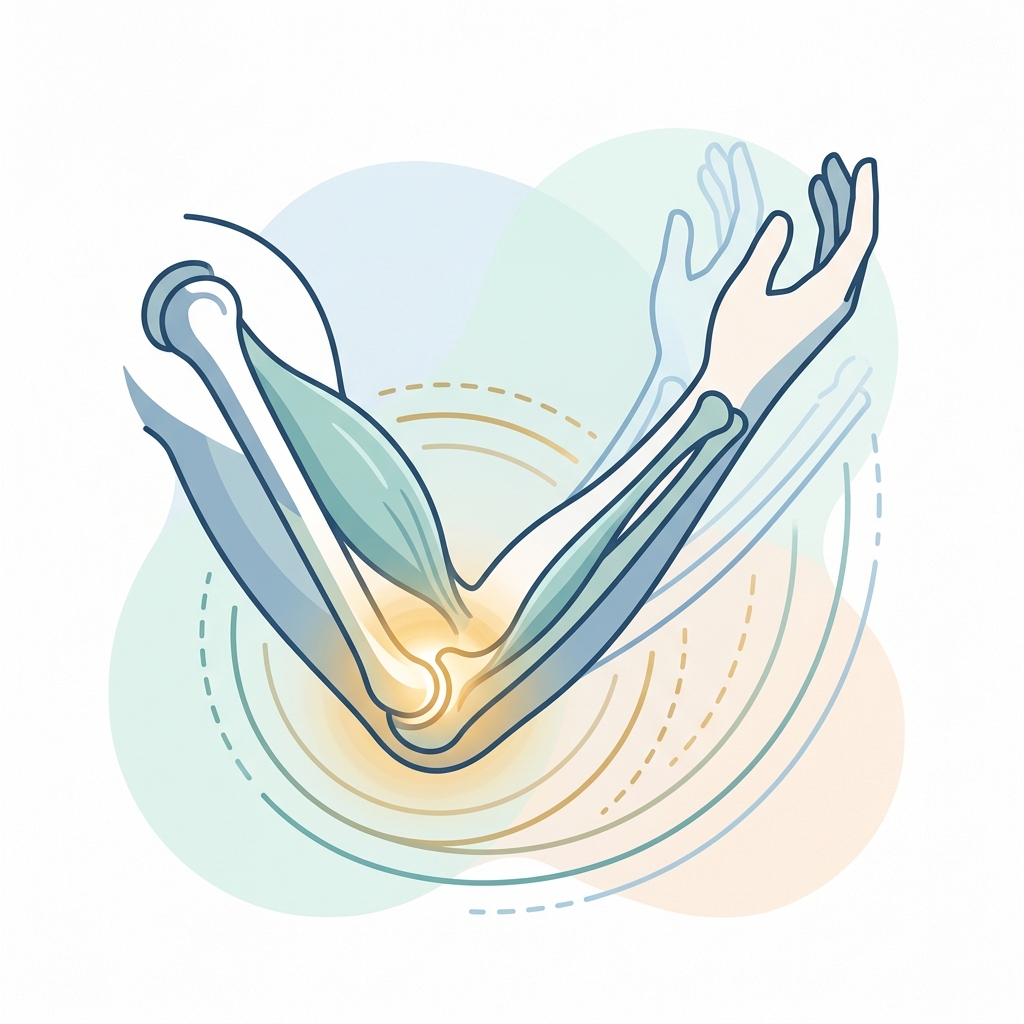
Distal Biceps Tendon Repair Protocol
Phase-by-phase post-operative rehabilitation protocol for Distal Biceps Tendon Repair to guide recovery and physical therapy.
A distal biceps tendon repair is a surgical procedure performed to reattach the ruptured distal biceps tendon back to its anatomical insertion on the radial tuberosity of the forearm. The success of this surgery depends heavily on a structured, phase-based rehabilitation program that balances protection of the healing tendon repair with the gradual restoration of elbow mobility, forearm rotation, and muscular strength. This protocol outlines the standard post-operative progression to guide patients and physical therapists toward a safe and complete recovery.
Phase I: Protection and Initial Healing (Weeks 0 to 2)
Goals:
- Protect the surgical repair site and ensure proper incision healing.
- Control and minimize post-operative pain and swelling.
- Maintain mobility in the fingers, hand, wrist, and shoulder of the affected arm.
- Ensure compliance with immobilization and activity restrictions.
Precautions & Restrictions:
- Wear the hinged elbow brace locked at 90 degrees of flexion at all times, including during sleep (except for hygiene and supervised physical therapy).
- No active elbow flexion (bending the elbow using your own biceps muscle).
- No active forearm supination (turning the palm upward).
- Strictly no lifting, carrying, pushing, or pulling with the surgical arm.
- Do not sleep on the surgical side.
Suggested Exercises:
- Hand squeezes (e.g., using a soft ball or putty) to maintain grip strength and reduce hand swelling.
- Active range of motion exercises for the fingers and thumb (full flexion and extension).
- Passive wrist flexion and extension stretching.
- Shoulder active range of motion exercises (flexion, abduction, and rotation) performed within a safe, pain-free range while keeping the elbow supported and bent at 90 degrees.
Criteria to Progress:
- Surgical incisions are fully closed and dry.
- Post-operative pain is well managed and swelling is stable or decreasing.
- Full understanding and strict adherence to bracing and movement precautions.
Phase II: Gradual Range of Motion (Weeks 2 to 6)
Goals:
- Gradually restore passive and active-assisted range of motion of the elbow.
- Prevent joint contractures and elbow stiffness.
- Improve forearm rotation (pronation and supination) within safe limits.
- Maintain general shoulder and wrist strength.
Precautions & Restrictions:
- Continue wearing the hinged elbow brace. The extension limit of the brace will be adjusted weekly by your therapist (typically starting at 45 degrees of extension at week 2, and increasing extension by 10 to 15 degrees each week).
- No active elbow flexion against gravity or resistance.
- No active forearm supination against resistance.
- Do not lift objects heavier than a cup of water (approximately 1 pound) with the surgical arm.
Suggested Exercises:
- Passive and active-assisted elbow flexion (using the non-surgical arm to help bend the elbow).
- Active-assisted elbow extension (allowing gravity or the other hand to gently straighten the elbow, stopping at the brace extension limit).
- Active-assisted forearm pronation (turning palm down) and supination (turning palm up) with the elbow bent at 90 degrees.
- Submaximal shoulder isometric exercises and light scapular stabilization drills (keeping the elbow bent at 90 degrees).
Criteria to Progress:
- Passive elbow range of motion is near full flexion and extension matches brace limits without significant pain.
- Forearm rotation is progressive and well tolerated.
- No signs of tendon irritation or increased inflammation.
Phase III: Active Range of Motion & Light Strengthening (Weeks 6 to 12)
Goals:
- Achieve full active range of motion of the elbow and forearm in all planes.
- Gradually discontinue the hinged elbow brace (typically around week 6 to 8, as cleared by your surgeon).
- Initiate light strengthening of the biceps and forearm muscles.
- Re-establish normal functional movement patterns for daily living tasks.
Precautions & Restrictions:
- Avoid sudden, jerky movements or ballistic activities with the arm.
- Limit lifting to a maximum of 5 pounds with the surgical arm until week 12.
- No heavy pulling, pushing, or carrying loads (e.g., groceries, backpacks).
- Avoid placing excessive stretch on the biceps muscle.
Suggested Exercises:
- Active elbow flexion and extension without assistance (active range of motion against gravity).
- Active forearm pronation and supination through the full available range.
- Light resisted forearm rotation using a light resistance band or a small hammer/dumbbell (1-2 pounds).
- Light biceps curls starting with 1-2 pounds, focusing on the concentric and eccentric phases.
- Shoulder, scapular, and wrist strengthening using light resistance bands or dumbbells.
- Gradual return to light activities of daily living (e.g., dressing, typing, eating).
Criteria to Progress:
- Pain-free full active range of motion of the elbow and forearm.
- Good quality of movement and muscle control during active exercises.
- Absence of pain or swelling at the surgical site with light resistance training.
Phase IV: Advanced Strengthening & Activity Return (Weeks 12 to 24+)
Goals:
- Restore maximum strength, power, and endurance of the biceps, forearm flexors/pronators, and shoulder girdle.
- Prepare for a safe return to recreational activities, sports, and occupational demands (including heavy manual labor).
- Maintain long-term elbow health, flexibility, and joint stability.
Precautions & Restrictions:
- Progress resistance slowly and methodically; avoid sudden leaps in weight.
- No maximal effort lifting, heavy pull-ups, or sudden high-impact loads on the biceps until fully cleared by the surgeon (usually after 5-6 months).
- Warm up thoroughly prior to exercise or heavy lifting.
Suggested Exercises:
- Progressive resisted biceps curls (gradually increasing weights as tolerated).
- Resisted forearm supination and pronation (using heavier weights or stronger bands).
- Closed-chain exercises such as push-ups and plank variations (initiated gradually and advanced as tolerated).
- Multi-joint upper body exercises including rowing, chest press, and lat pull-downs (starting light and building up).
- Work-specific and sport-specific activities (e.g., throwing progression, tool use, weightlifting modifications).
Criteria to Progress:
- Elbow flexion and forearm supination strength is at least 85% to 90% compared to the uninvolved side.
- Complete, pain-free execution of advanced daily activities and exercise routines.
- Clearance from the orthopaedic surgeon to return to unrestricted sports, heavy lifting, or manual labor.
These guidelines represent a standard rehabilitation protocol. Individual recovery rates vary significantly depending on the size of the repair, bone/tissue quality, and general patient health. Your surgeon may modify this protocol specifically for you.
Disclaimer: This protocol is for educational purposes and is not a substitute for professional medical advice. Always consult your surgeon or physical therapist before performing any exercises or modifying activity restrictions.

Related articles
Browse all articlesTrusted External Resources
Curated educational materials to help you make informed decisions about your orthopaedic bone & joint conditions.

Orthopaedia
Orthogate Patient Education