
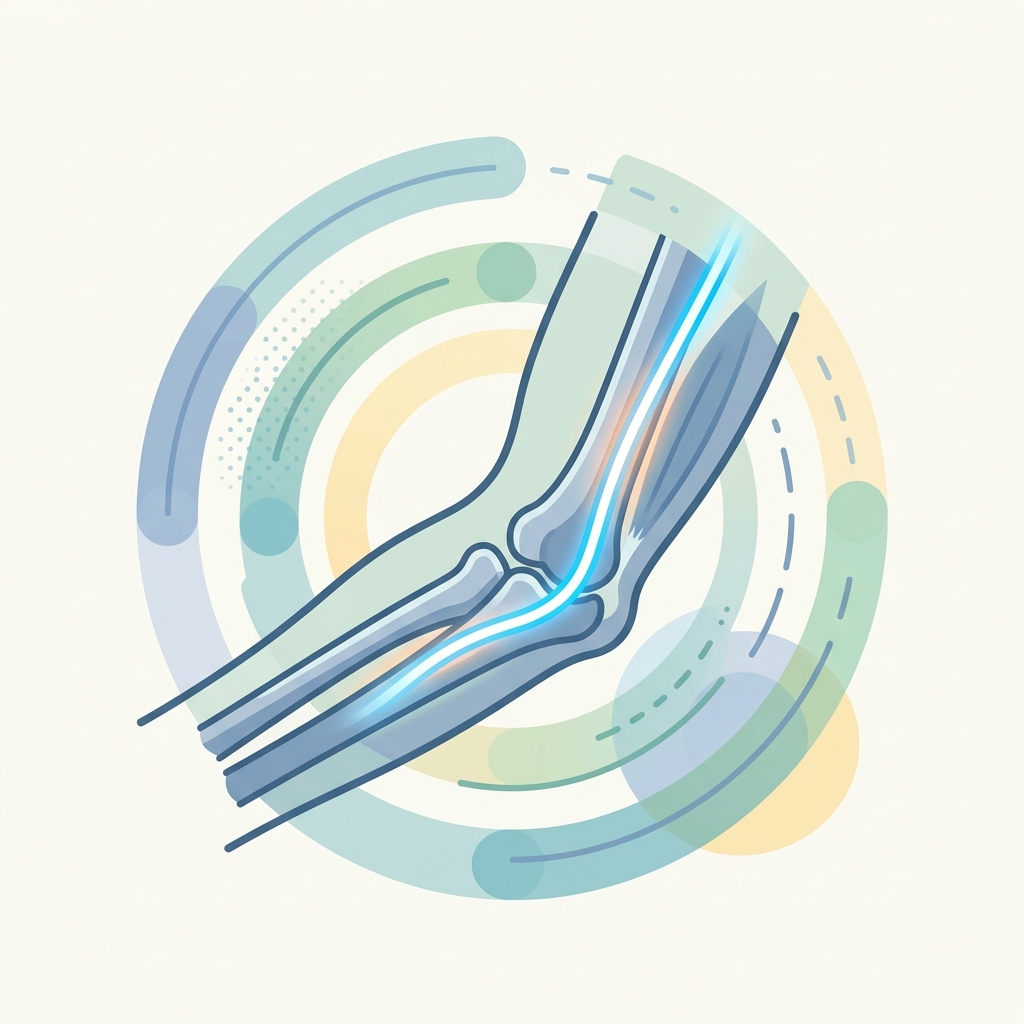
Ulnar Nerve Transposition Protocol
Phase-by-phase post-operative rehabilitation protocol for Ulnar Nerve Transposition to guide recovery and physical therapy.
Anterior transposition of the ulnar nerve is a surgical procedure performed to relieve symptoms of cubital tunnel syndrome by repositioning the ulnar nerve from its native groove behind the medial epicondyle to a new path in front of it. This relocation eliminates tension and compression on the nerve during elbow flexion. A structured, phase-based rehabilitation plan is essential to protect the nerve during early healing, prevent scar tissue adhesions, and safely restore range of motion and upper extremity strength.
Phase I: Protection & Early Motion (Weeks 0 - 2)
The primary focus of this initial phase is to protect the surgical site and the transposed nerve, control post-operative swelling and pain, and initiate very gentle movement to prevent stiffness without stressing the healing tissues.
- Goals:
- Protect the surgical site and nerve transposition repair.
- Control pain, inflammation, and local swelling.
- Maintain active range of motion (AROM) in the fingers, wrist, and shoulder.
- Minimize muscle atrophy in the hand and forearm.
- Precautions & Restrictions:
- Keep the post-operative splint or dressing clean and dry.
- Avoid active or passive elbow extension beyond the limits specified by the surgeon (often maintained in 90 degrees flexion in a splint for the first week, or restricted to 30-90 degrees if early motion is cleared).
- No lifting, carrying, or pushing/pulling with the surgical arm (limit weight to less than a cup of water).
- Avoid direct pressure on the medial elbow incision.
- Suggested Exercises:
- Active range of motion (AROM) for the fingers, thumb, and wrist (flexion/extension) to maintain mobility and decrease edema.
- Gentle shoulder shrugs, shoulder retraction, and active shoulder range of motion (avoiding positions that place excessive tension on the medial elbow).
- If cleared for a removable splint: gentle, passive or active-assisted elbow range of motion (typically restricted from 30 degrees extension to 100 degrees flexion).
- Criteria to Progress:
- Incision is healed and sutures/staples are removed (usually around day 10-14).
- Pain and swelling are stable and controlled.
- Completion of 2 weeks post-operation.
Phase II: Active Motion & Nerve Gliding (Weeks 2 - 6)
In this phase, the post-operative splint is typically discontinued (or transitioned to a removable sleeve), and the focus shifts to restoring full active range of motion and introducing gentle nerve gliding to prevent the ulnar nerve from becoming scarred or tethered to surrounding tissues.
- Goals:
- Gradually restore full active range of motion (AROM) of the elbow and forearm.
- Initiate gentle ulnar nerve sliding/gliding exercises.
- Promote soft tissue mobility and decrease scar tissue formation.
- Begin light activities of daily living (ADLs).
- Precautions & Restrictions:
- Avoid aggressive passive elbow extension stretching; range of motion should progress naturally and comfortably.
- No heavy lifting, pushing, or pulling (limit load to less than 5 pounds).
- Avoid prolonged, continuous elbow flexion (e.g., sleeping with elbow fully bent, holding a phone to the ear for extended periods) which can compress or stretch the nerve.
- Suggested Exercises:
- Active-assisted (AAROM) and active (AROM) elbow flexion and extension in a pain-free range.
- Active forearm pronation and supination exercises.
- Submaximal isometric elbow flexion, extension, pronation, and supination.
- Gentle ulnar nerve gliding/sliding exercises (starting with short ranges and low repetitions to avoid nerve irritation).
- Gentle scar tissue massage once the incision is fully healed and scab-free.
- Light grip strengthening (e.g., soft putty, squeeze ball).
- Criteria to Progress:
- Full or near-full active elbow and forearm range of motion without significant pain.
- Minimal to no ulnar nerve symptoms (no radiating pain or paresthesia) during active movement.
- Stable joint and tissues, cleared by the physical therapist or surgeon.
Phase III: Progressive Strengthening (Weeks 6 - 12)
Once range of motion is restored and the ulnar nerve has stabilized in its new position, progressive resistance exercises are introduced to rebuild strength, endurance, and function throughout the entire upper extremity.
- Goals:
- Maintain pain-free elbow and forearm range of motion.
- Rebuild strength and muscular endurance in the forearm, elbow, shoulder, and scapular stabilizers.
- Return to normal, unrestricted activities of daily living (ADLs).
- Maintain ulnar nerve mobility.
- Precautions & Restrictions:
- Avoid sudden, jerking movements or hyperextension of the elbow under heavy load.
- Monitor closely for any recurrence of ulnar nerve irritation (numbness, tingling in the ring and small fingers). If symptoms arise, reduce intensity or regress exercises.
- Suggested Exercises:
- Progressive resistance exercises (PREs) for elbow flexion and extension using light dumbbells or resistance bands.
- Forearm strengthening (pronation/supination, wrist flexion/extension) with progressive loads.
- Rotator cuff and scapular stabilization exercises (e.g., rows, Y-T-Ws, wall slides) to support the kinetic chain.
- Ulnar nerve tensioning/gliding exercises as tolerated to maintain neural mobility.
- Closed kinetic chain exercises (e.g., gentle wall push-ups, quadruped weight-bearing).
- Criteria to Progress:
- Full, pain-free elbow and forearm range of motion.
- Upper extremity strength at least 80% compared to the uninvolved side.
- No neural symptoms (numbness, tingling, or radiating pain) at rest or during exercise.
Phase IV: Advanced Strengthening & Return to Activity (Weeks 12+)
The final phase focuses on returning the patient to full, unrestricted work, sports, and high-demand recreational activities. Exercises are progressed to include dynamic, power, and activity-specific movements.
- Goals:
- Restore full strength, power, and endurance of the upper extremity.
- Initiate sport-specific or work-specific conditioning.
- Ensure safe, successful return to unrestricted functional activities, including heavy lifting or throwing.
- Precautions & Restrictions:
- Gradually phase in high-demand activities; avoid sudden, unconditioned return to maximal loading or competition.
- Monitor for post-activity soreness or neural irritation and adjust training volume accordingly.
- Suggested Exercises:
- Advanced upper extremity strengthening (e.g., progress to standard push-ups, pull-downs, chest press).
- Plyometric training (e.g., medicine ball chest passes, overhead throws) for throwing or overhead athletes.
- Sport-specific drills (e.g., gradual throwing progression, racket swings, golf swings).
- Work-specific task simulation.
- Ongoing ulnar nerve gliding and forearm stretching as part of a regular maintenance program.
- Criteria to Progress:
- Full, pain-free functional movement and normal clinical examination.
- Equal upper extremity strength and endurance compared to the opposite side.
- Clearance from the orthopedic surgeon for unrestricted work, sports, and heavy lifting.
These guidelines represent a standard rehabilitation protocol. Individual recovery rates vary significantly depending on the size of the repair, bone/tissue quality, and general patient health. Your surgeon may modify this protocol specifically for you.
Disclaimer: This protocol is for educational purposes and is not a substitute for professional medical advice. Always consult your surgeon or physical therapist before performing any exercises or modifying activity restrictions.

Related articles
Browse all articlesTrusted External Resources
Curated educational materials to help you make informed decisions about your orthopaedic bone & joint conditions.

Orthopaedia
Orthogate Patient Education