
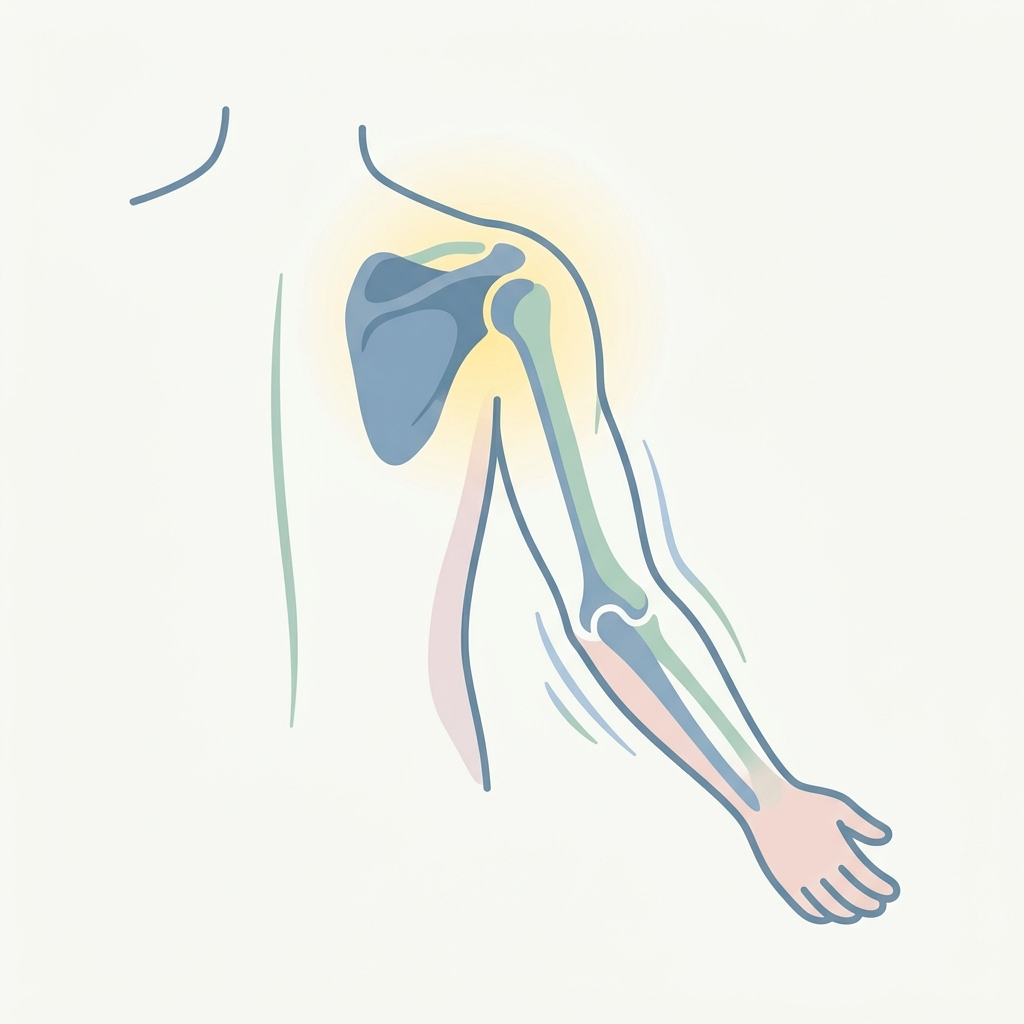
Shoulder and Scapular Stability Exercises
Step-by-step home exercise guide for Shoulder and Scapular Stability to improve mobility, strength, and elbow health.
Many chronic elbow conditions, such as tennis elbow (lateral epicondylitis) or golfer's elbow (medial epicondylitis), are not actually caused by problems in the elbow itself. Often, they stem from weakness or instability further up the kinetic chain, particularly in the shoulder joint and the shoulder blade (scapula). Because the elbow is a hinge joint positioned between the shoulder and the wrist, any instability at the shoulder forces the elbow to work harder to compensate. By building a strong foundation of shoulder and scapular stability, you can reduce the compensation load on your elbow, relieve strain, and prevent future injury.
General Guidelines & Safety Precautions
- Warm-Up: Spend 5 minutes doing light activity, such as arm swings or shoulder rolls, before starting.
- The Pain Rule: Exercises should feel challenging but should not cause sharp or shooting pain. If you feel pain in your shoulder or elbow, stop immediately and consult your therapist.
- Frequency: Perform these exercises 3 to 4 times a week, or as recommended by your care team.
Exercise 1: Scapular Wall Slides
Purpose: Activates the serratus anterior and lower trapezius muscles to help the shoulder blade move smoothly and stabilize the shoulder girdle.
Equipment Needed: None (just a flat wall).
Starting Position: Stand with your back flat against a wall, with your heels about 6 inches away. Keep your head, upper back, and buttocks touching the wall.
Step-by-Step Instructions:
- Raise your arms so that your elbows and the back of your hands touch the wall at shoulder height (forming a \"W\" shape).
- Gently press your lower back toward the wall to engage your core muscles.
- Slowly slide your hands and elbows up the wall, keeping constant contact with the wall.
- Go only as high as you can without your back arching or hands losing contact.
- Slowly slide back down to the starting \"W\" position.
Dosage: 2 sets of 10 to 12 repetitions, once daily.
Tips/Common Mistakes: Do not shrug your shoulders up to your ears. Keep your shoulder blades pressed flat against the wall throughout the entire movement.
Exercise 2: Prone Y-T-W Raises
Purpose: Strengthens the critical stabilizing muscles around the shoulder blade (middle and lower trapezius, rhomboids) to keep your arm alignment strong and prevent elbow strain.
Equipment Needed: An exercise mat or firm bed.
Starting Position: Lie face down on your stomach. Place a small, rolled-up towel under your forehead to keep your neck in a neutral, relaxed position.
Step-by-Step Instructions:
- Y Position: Place your arms overhead at a 45-degree angle (forming a 'Y') with your thumbs pointing up. Lift your arms off the floor by squeezing your shoulder blades down and back. Hold for 2 seconds, then lower.
- T Position: Move your arms straight out to the sides (forming a 'T') with thumbs pointing up. Lift your arms by squeezing your shoulder blades together. Hold for 2 seconds, then lower.
- W Position: Bend your elbows and pull them down toward your ribs (forming a 'W'). Lift your elbows and hands together, squeezing your shoulder blades. Hold for 2 seconds, then lower.
Dosage: Perform 1 set of 10 repetitions for each position (Y, T, W), once daily.
Tips/Common Mistakes: Do not lift your head or arch your lower back. The movement should come entirely from your shoulder blades and upper back.
Exercise 3: Resisted Shoulder External Rotation
Purpose: Strengthens the rotator cuff muscles, which stabilize the shoulder joint, allowing your arm to rotate safely without placing undue stress on the elbow.
Equipment Needed: A light resistance band and a small rolled towel.
Starting Position: Stand tall with your shoulders relaxed. Tuck a small rolled towel under the arm of your target side, holding it against your ribs. Hold the resistance band with both hands.
Step-by-Step Instructions:
- Bend your target elbow to 90 degrees, keeping your forearm pointing straight forward.
- Keeping your elbow tucked against the towel, slowly rotate your forearm outward, away from your body.
- Control the band as you slowly return to the starting position.
- Keep your elbow bent at 90 degrees and do not let the towel drop.
Dosage: 3 sets of 10 repetitions, once daily.
Tips/Common Mistakes: Avoid twisting your body or lifting your shoulder. Only your forearm should move, pivoting around your elbow.
Exercise 4: Serratus Punches
Purpose: Strengthens the serratus anterior, which stabilizes the shoulder blade against the rib cage and prevents \"winging\" that leads to poor elbow mechanics.
Equipment Needed: A light dumbbell or soup can (optional).
Starting Position: Lie flat on your back on a mat or bed.
Step-by-Step Instructions:
- Extend your target arm straight up toward the ceiling. Keep your elbow locked straight.
- Reach your hand further up toward the ceiling by lifting your shoulder blade off the floor. Do not bend your elbow.
- Hold this position for 2 seconds.
- Slowly lower your shoulder blade back flat onto the floor, keeping your arm straight.
Dosage: 2 sets of 15 repetitions, once daily.
Tips/Common Mistakes: Do not bend your elbow or twist your neck. The movement is small and focused entirely on moving your shoulder blade forward and back.
Always consult with your physical therapist or doctor before starting a new exercise routine. If any exercise causes persistent pain or swelling, discontinue it and contact your healthcare provider.
Disclaimer: This guide provides general exercise instructions and is not a substitute for professional medical advice. Always consult your doctor or qualified healthcare provider with any questions you may have regarding your specific medical condition and treatment plan.

Related articles
Browse all articlesTrusted External Resources
Curated educational materials to help you make informed decisions about your orthopaedic bone & joint conditions.

Orthopaedia

Orthogate Patient Education