
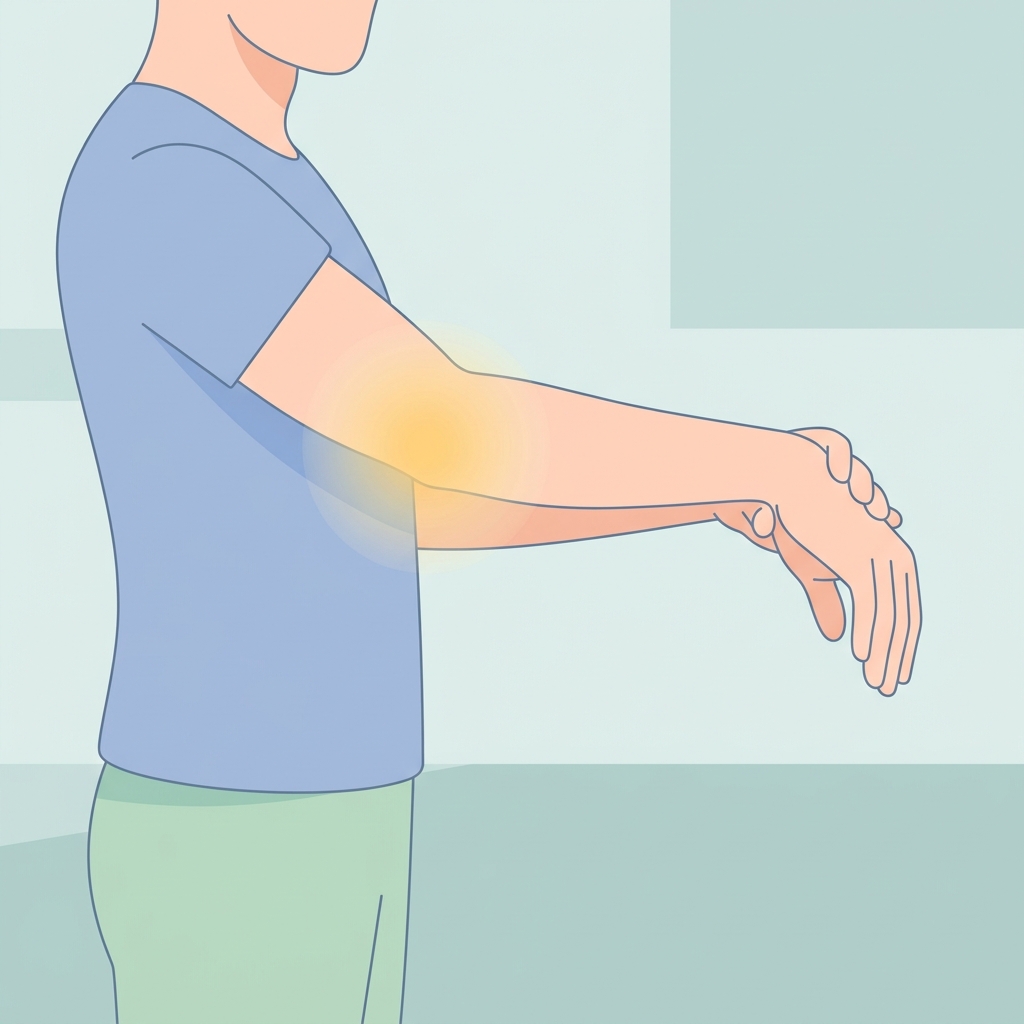
Tennis Elbow (Lateral Epicondylitis) Rehabilitation Exercises
Step-by-step home exercise guide for Tennis Elbow (Lateral Epicondylitis) Rehabilitation to improve mobility, strength, and recovery.
Active rehabilitation is a key component of recovery for Tennis Elbow (Lateral Epicondylitis). Doing targeted exercises helps stretch and strengthen the forearm muscles and tendons, promotes blood flow for healing, and prevents future recurrence. This guide outlines a safe, progressive home exercise program designed to help you regain full forearm function and reduce pain.
General Guidelines & Safety Precautions
To ensure a safe and effective rehabilitation process, please follow these guidelines:
- Warm-up: Warm up your arm before beginning the exercises by gently moving your wrist and elbow in circles, or applying a warm compress for 5 to 10 minutes.
- The Pain Rule: Exercises should feel like a gentle stretch or a mild muscle workout. Stop immediately if you feel sharp, stabbing, or radiating pain.
- Pace Yourself: Perform each exercise slowly and with control. Avoid jerky movements or forcing any motion.
The Exercises
Exercise 1: Wrist Extensor Stretch
Purpose: To gently stretch and lengthen the wrist extensor muscles and tendons on the outside of your forearm.
Equipment Needed: None.
Starting Position: Extend your affected arm straight out in front of you at shoulder level, with your palm facing down.
Instructions:
- Keep your elbow straight.
- Use your opposite hand to grasp the fingers of your affected hand.
- Gently pull your hand down toward your body until you feel a comfortable stretch along the top of your forearm.
- Hold the stretch for 15 to 30 seconds.
- Slowly release and return to the starting position.
Dosage: Perform 3 repetitions, 2 to 3 times per day.
Tips & Mistakes to Avoid: Keep your elbow fully extended; do not bounce or pull too aggressively.
Exercise 2: Wrist Flexor Stretch
Purpose: To stretch the opposing muscle groups (wrist flexors) to maintain balanced flexibility across the wrist and forearm.
Equipment Needed: None.
Starting Position: Extend your affected arm straight out in front of you at shoulder level, with your palm facing up.
Instructions:
- Keep your elbow straight.
- Use your opposite hand to grasp the fingers of your affected hand.
- Gently pull your hand down toward the floor, bending your wrist back, until you feel a stretch along the underside of your forearm.
- Hold the stretch for 15 to 30 seconds.
- Slowly release and return to the starting position.
Dosage: Perform 3 repetitions, 2 to 3 times per day.
Tips & Mistakes to Avoid: Ensure your shoulder is relaxed and not raised toward your ear. Only stretch to a comfortable pull.
Exercise 3: Wrist Eccentric Extension
Purpose: To strengthen the wrist extensor tendons under controlled elongation. Eccentric exercise is highly effective for tendon repair and building load tolerance.
Equipment Needed: A very light dumbbell (1 to 2 lbs) or a soup can.
Starting Position: Sit in a chair. Rest your forearm on a flat table or your thigh, with your wrist hanging over the edge and your palm facing down.
Instructions:
- Use your healthy hand to lift the weight up (bending your wrist upward).
- Remove your healthy hand from the weight.
- Slowly lower the weight back down using only your affected hand. This lowering phase should take a full 3 to 5 seconds.
- Once lowered, use your healthy hand again to lift the weight back to the top. Repeat the process.
Dosage: Perform 2 sets of 10 repetitions, once per day.
Tips & Mistakes to Avoid: Do not lift the weight up using your affected hand, as the lifting phase (concentric) can irritate the tendon during early recovery. Focus entirely on the slow, controlled lowering phase.
Exercise 4: Forearm Supination and Pronation
Purpose: To restore rotational strength and flexibility to the forearm muscles that control twisting movements.
Equipment Needed: A light hammer, a broom handle, or a light dumbbell held at one end.
Starting Position: Sit in a chair. Rest your forearm flat on a table, holding the bottom of the hammer or weight handle with your hand in a neutral \"thumbs-up\" position.
Instructions:
- Slowly rotate your forearm outward so that your palm faces upward (supination). Keep the motion controlled.
- Return slowly to the neutral starting position.
- Slowly rotate your forearm inward so that your palm faces downward (pronation).
- Return slowly to the neutral starting position.
Dosage: Perform 2 sets of 10 to 15 repetitions, once per day.
Tips & Mistakes to Avoid: Keep your elbow bent at 90 degrees and tucked close to your body to isolate the forearm rotation and avoid using your shoulder to swing the weight.
Exercise 5: Grip Strength (Rolled Towel or Ball Squeeze)
Purpose: To rebuild hand grip strength, which is often weakened by tennis elbow, and support wrist stability.
Equipment Needed: A soft stress ball, a tennis ball, or a rolled-up washcloth.
Starting Position: Sit or stand comfortably, holding the stress ball or rolled towel in your affected hand.
Instructions:
- Gently squeeze the ball or towel as hard as you can without causing pain.
- Hold the squeeze for 5 seconds.
- Slowly release your grip.
- Repeat the squeeze.
Dosage: Perform 10 to 15 repetitions, once per day.
Tips & Mistakes to Avoid: Do not squeeze to the point of pain. If your elbow hurts during or after the squeeze, reduce the intensity of your squeeze or use a softer object.
Always consult with your physical therapist or doctor before starting a new exercise routine. If any exercise causes persistent pain or swelling, discontinue it and contact your healthcare provider.
Disclaimer: This guide provides general exercise instructions and is not a substitute for professional medical advice. Always consult your doctor or qualified healthcare provider with any questions you may have regarding your specific medical condition and treatment plan.

Related articles
Browse all articlesTrusted External Resources
Curated educational materials to help you make informed decisions about your orthopaedic bone & joint conditions.

Orthopaedia
Orthogate Patient Education