
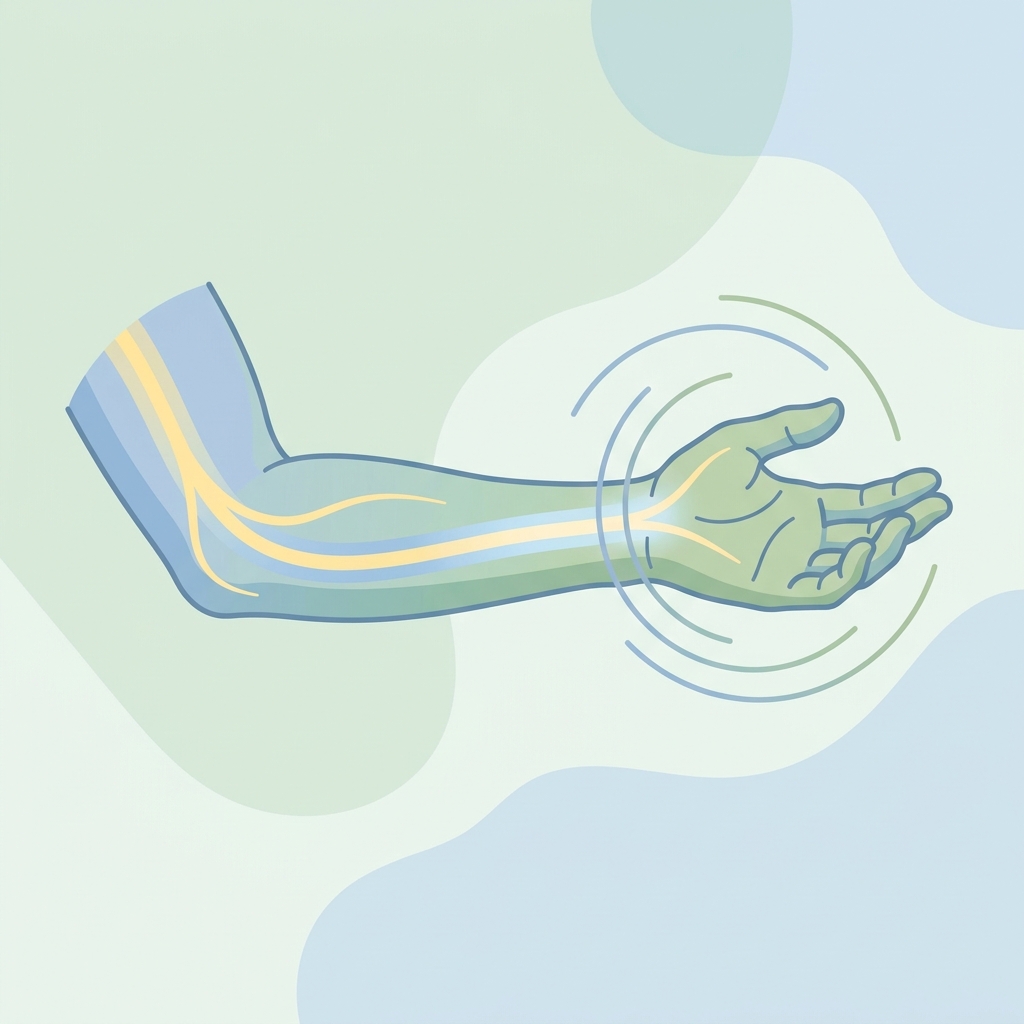
Pronator Syndrome (Median Nerve) Gliding Exercises
Step-by-step home exercise guide for Pronator Syndrome (Median Nerve) Gliding Exercises to improve mobility, strength, and recovery.
Pronator syndrome occurs when the median nerve becomes compressed as it travels through the forearm, particularly near the pronator teres muscle. This compression can cause pain, aching, or numbness in the forearm, hand, and fingers. Pronator Syndrome (Median Nerve) Gliding Exercises are designed to help the median nerve slide smoothly through the surrounding tissues, reducing friction, relieving irritation, and promoting healing. Incorporating these exercises into your daily routine can significantly improve mobility and reduce symptoms.
General Guidelines & Safety Precautions
- Warm-Up: Perform a few gentle shoulder rolls and arm swings to promote circulation before starting.
- The Pain Rule: These exercises should feel like a gentle stretch or glide, never painful. If you experience sharp, shooting pain, or a sudden increase in numbness or tingling, stop immediately.
- Be Gentle: Nerves have a sensitive blood supply. Do not stretch them aggressively. Think of these movements as a gentle flossing action rather than a hard muscle stretch.
Exercise 1: Median Nerve Slider (Active Flossing)
Purpose: To gently glide the median nerve back and forth through the pronator tunnel without putting excessive tension on it.
Equipment Needed: None.
Starting Position: Sit or stand tall with relaxed shoulders. Raise your affected arm out to the side at shoulder height, elbow bent at 90 degrees, and wrist relaxed (fingers curled gently toward your shoulder).
Step-by-Step Instructions:
- Slowly straighten your elbow and extend your wrist so your palm faces up, pointing your fingers toward the floor.
- As you extend your arm and wrist, tilt your head toward the opposite shoulder (away from the arm). This keeps tension low on one end while pulling from the other.
- Slowly return to the starting position (bend elbow, curl wrist) while bringing your head back to the center or tilting it toward the active shoulder.
- Perform this movement in a slow, smooth, rhythmic motion.
Dosage: Perform 10 to 15 repetitions, 1 to 2 times per day.
Tips & Common Mistakes: Do not hold the end position. This is a dynamic gliding movement, not a static stretch. Avoid shrugging your shoulder toward your ear during the exercise.
Exercise 2: Pronator Teres Stretch
Purpose: To stretch and relax the pronator teres muscle, reducing compression on the median nerve.
Equipment Needed: None.
Starting Position: Sit or stand tall. Extend your affected arm straight out in front of you at shoulder height, palm facing down.
Step-by-Step Instructions:
- Use your opposite hand to grasp the palm of your affected hand.
- Gently rotate your forearm so that your thumb turns outward (supination) and your palm faces upward.
- Apply a gentle downward pressure on your hand to extend your wrist slightly, enhancing the stretch in the forearm.
- Hold this stretch comfortably. You should feel a mild stretch along the thumb side and front of your forearm.
Dosage: Hold for 20 to 30 seconds. Repeat 3 times, 2 times per day.
Tips & Common Mistakes: Keep your elbow straight to isolate the pronator teres muscle. Do not force the stretch to the point of pain or numbness.
Exercise 3: Active Forearm Supination and Pronation
Purpose: To restore normal mobility and flexibility to the forearm muscles that surround the median nerve.
Equipment Needed: A light hammer, a cane, or a lightweight dumbbell (1-2 lbs) gripped by one end.
Starting Position: Sit in a chair with your elbow bent to 90 degrees and supported by your thigh or a table, forearm in a neutral position (thumb pointing up).
Step-by-Step Instructions:
- Hold the bottom of the hammer handle or cane in your hand.
- Slowly rotate your forearm outward so your palm faces up (supination), letting the weight of the hammer gently assist the stretch. Hold for 2 seconds.
- Slowly rotate your forearm inward so your palm faces down (pronation). Hold for 2 seconds.
- Control the movement throughout the entire range of motion, using your muscles to stabilize the forearm.
Dosage: Perform 10 to 12 repetitions in each direction, 1 to 2 times per day.
Tips & Common Mistakes: Keep your elbow close to your side and bent at 90 degrees to prevent your shoulder from doing the work. Use a very light weight; the goal is mobility, not strength training.
Exercise 4: Median Nerve Wall Glide
Purpose: To stretch the median nerve and chest muscles (pectoralis), which can also contribute to nerve entrapment.
Equipment Needed: A wall.
Starting Position: Stand sideways next to a wall, about an arm's length away. Place the palm of your affected hand flat on the wall at shoulder height, with your fingers pointing backward (away from you).
Step-by-Step Instructions:
- Keep your elbow slightly bent and fingers flat against the wall.
- Gently turn your body away from the wall until you feel a mild stretch in your chest, front of the shoulder, and down your arm.
- Hold this position while gently tilting your head away from the wall (ear to opposite shoulder) to increase the stretch, then tilt it back to release.
- Only tilt your head back and forth gently; do not hold a high-tension position.
Dosage: Perform 10 gentle head tilts, repeat 2 to 3 times, once daily.
Tips & Common Mistakes: Do not lock your elbow out completely. Keep your shoulder blade drawn down and back; do not let it shrug up.
Always consult with your physical therapist or doctor before starting a new exercise routine. If any exercise causes persistent pain or swelling, discontinue it and contact your healthcare provider.
Disclaimer: This guide provides general exercise instructions and is not a substitute for professional medical advice. Always consult your doctor or qualified healthcare provider with any questions you may have regarding your specific medical condition and treatment plan.

Related articles
Browse all articlesTrusted External Resources
Curated educational materials to help you make informed decisions about your orthopaedic bone & joint conditions.

Orthopaedia

Orthogate Patient Education