
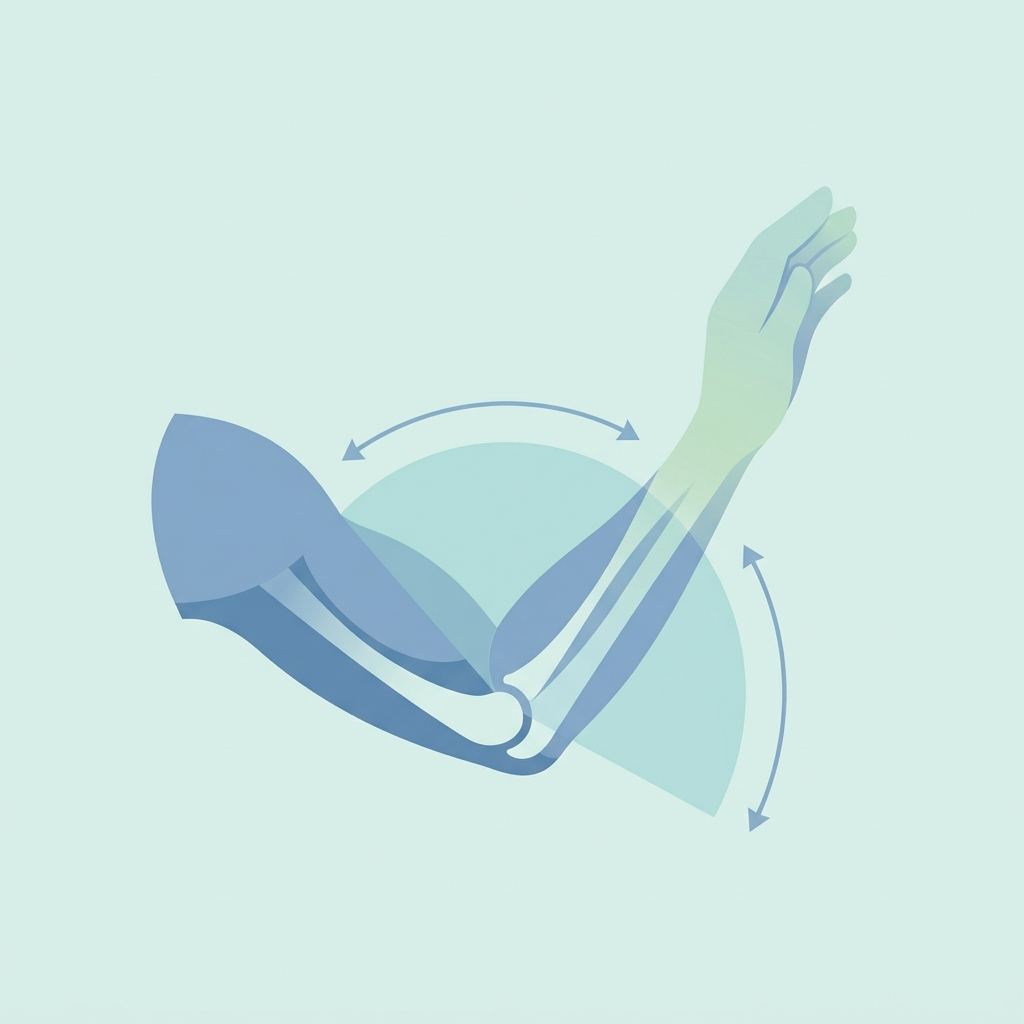
Elbow Stiffness and Contracture Recovery Exercises
Step-by-step home exercise guide for Elbow Stiffness and Contracture Recovery to improve mobility, strength, and recovery.
Elbow stiffness and joint contractures are common complications following an injury, surgery, or a period of immobilization (such as being in a cast or splint). The elbow joint is highly sensitive, and the surrounding joint capsule and ligaments can quickly tighten. Active, gentle rehabilitation under clinical guidance is essential to restore your range of motion. Under the supervision of Dr. Christian Veillette, this home exercise guide is designed to help you safely regain elbow flexion (bending), extension (straightening), and forearm rotation (pronation and supination).
General Guidelines & Safety Precautions
To get the most out of your home exercise program and prevent joint irritation, please follow these guidelines:
- Warm-Up: Apply a warm compress or heating pad to the elbow for 10 to 15 minutes before stretching to relax tight tissues and increase blood flow.
- Pain Rule: Stretching should feel like a mild to moderate pull or tension. It should never cause sharp, stabbing, or severe pain. If you experience sharp pain, back off the stretch immediately.
- No Bouncing: Perform all stretches slowly and hold them steadily. Bouncing can cause microscopic tears in the healing tissues, leading to more scarring and stiffness.
- Consistency: The elbow joint responds best to frequent, gentle stretches throughout the day rather than one aggressive session.
Exercise 1: Passive-Assisted Elbow Extension Stretch
Purpose: To restore full straightening (extension) of the elbow joint by gently lengthening the tight tissues on the front of the joint.
Equipment Needed: A table, a rolled-up towel, and a light weight (such as a soup can or a 1-to-2 pound dumbbell).
Starting Position: Sit comfortably in a chair next to a table. Place the arm you want to stretch on the table with your upper arm supported and your elbow and forearm extending off the edge.
Step-by-Step Instructions:
- Place a rolled-up towel under your upper arm just above the elbow joint to cushion it and keep your shoulder relaxed.
- Let your forearm hang over the edge of the table, allowing gravity to gently pull your arm downward toward the floor.
- Hold a light weight (1 to 2 pounds) in your hand to add a gentle, continuous stretch, or use your opposite hand to apply a very light downward pressure on your wrist.
- Relax your arm muscles completely and let gravity do the work.
- Hold this stretched position for 30 to 60 seconds.
- Slowly use your opposite arm to help lift the stretched arm back to a bent, relaxed position.
Dosage/Parameters: Hold for 30 to 60 seconds. Repeat 3 to 4 times per session. Complete 2 to 3 sessions daily.
Tips/Common Mistakes: Do not use a heavy weight. If the weight is too heavy, your muscles will automatically tense up to protect the joint, which prevents the capsule from stretching.
Exercise 2: Active-Assisted Elbow Flexion Stretch
Purpose: To improve elbow bending (flexion) range of motion, which is crucial for daily tasks like eating, brushing teeth, and washing your face.
Equipment Needed: None.
Starting Position: Sit or stand tall with your shoulders relaxed and your arm at your side.
Step-by-Step Instructions:
- Bend your stiff elbow under its own power as far as you comfortably can.
- Place your opposite hand on the wrist or hand of the stiff arm.
- Gently apply a steady pressure, pushing your hand closer toward your shoulder until you feel a firm but comfortable stretch in the back of the elbow.
- Hold the stretch position for 20 to 30 seconds while breathing deeply.
- Slowly release the pressure and lower your arm back down to a relaxed position.
Dosage/Parameters: Hold for 20 to 30 seconds. Repeat 4 to 5 times per session. Complete 2 to 3 sessions daily.
Tips/Common Mistakes: Avoid shrugging your shoulder or bending your neck forward to meet your hand. Keep your posture upright and your shoulders level throughout the stretch.
Exercise 3: Forearm Pronation Stretch
Purpose: To restore the ability to rotate your forearm downward (pronation), which is needed for typing, writing, and using utensils.
Equipment Needed: A table or a chair armrest.
Starting Position: Sit in a chair with your elbow bent to 90 degrees and supported by a table or your thigh. Your hand should start in a neutral "handshake" position (thumb pointing up).
Step-by-Step Instructions:
- Keep your elbow tucked firmly against your side at a 90-degree angle.
- Rotate your forearm so your palm turns face down toward the floor as far as possible.
- Use your opposite hand to grasp the outer side of your wrist and gently rotate it a little further to feel a mild stretch in the forearm.
- Hold this stretch for 20 to 30 seconds.
- Slowly return to the starting position.
Dosage/Parameters: Hold for 20 to 30 seconds. Repeat 3 to 4 times per session. Complete 2 sessions daily.
Tips/Common Mistakes: Do not allow your elbow to slide away from your body or your shoulder to roll inward. Keeping your elbow pinned to your side isolates the rotation to the forearm.
Exercise 4: Forearm Supination Stretch
Purpose: To restore the ability to rotate your forearm upward (supination), which is essential for carrying objects, holding bowls, and turning doorknobs.
Equipment Needed: A table or a chair armrest.
Starting Position: Sit in a chair with your elbow bent to 90 degrees and supported. Start with your hand in a neutral "handshake" position (thumb pointing up).
Step-by-Step Instructions:
- Keep your elbow tucked firmly against your side at a 90-degree angle.
- Rotate your forearm so your palm turns face up toward the ceiling as far as possible.
- Use your opposite hand to grasp your wrist and gently rotate your palm further upward until you feel a comfortable stretch in your forearm.
- Hold the stretch for 20 to 30 seconds.
- Slowly return to the starting handshake position.
Dosage/Parameters: Hold for 20 to 30 seconds. Repeat 3 to 4 times per session. Complete 2 sessions daily.
Tips/Common Mistakes: Make sure you do not tilt your wrist sideways or flare your elbow out. Keep the movement restricted to pure forearm rotation.
Always consult with your physical therapist or doctor before starting a new exercise routine. If any exercise causes persistent pain or swelling, discontinue it and contact your healthcare provider.
Disclaimer: This guide provides general exercise instructions and is not a substitute for professional medical advice. Always consult your doctor or qualified healthcare provider with any questions you may have regarding your specific medical condition and treatment plan.

Related articles
Browse all articlesTrusted External Resources
Curated educational materials to help you make informed decisions about your orthopaedic bone & joint conditions.

Orthopaedia

Orthogate Patient Education